CHINATOWN | WALKING TOUR
Type Heritage Learning, Public Engagement
Team Zihao Zhang (WanderLens Lab), Daoxin Chen (WanderLens Lab), Mina Wei (UCN in Columbia University), XXX (UCN in Columbia University), Hongqian Li (Columbia University), Mengyao Chen (Columbia University), Bayer Lee (First Chinese Baptist Church), Fei Deng (Hong Kong University), Christina Sun (Hong Kong Chinese University)
Time October 2024 - November 2024
To conncet the heritage learning with the public, we initiated the project named as “Reimagining Global Chinatown in Megacities: A Multidisciplinary Workshop on Innovative Local Storytelling”. To organize the project, we assume when individual experiences meet the collective living space of the American-Chinese community, and when global perspectives meet the local realities of Chinese immigrants, a rich tapestry of new stories can emerge. Outsiders can offer unique insights and fresh perspectives to the narratives of Chinatown, which can deeply enhance our understanding of Chinatown’s unique cultural and social dynamics.
The project including a walking tour and a paticipatory design workshop, for which we recruiting ten participants, including students, amaters of heritage and preservationists. All of them can be regarded as outsiders of Chinatown, whose kowledge of Chinatown are varied.
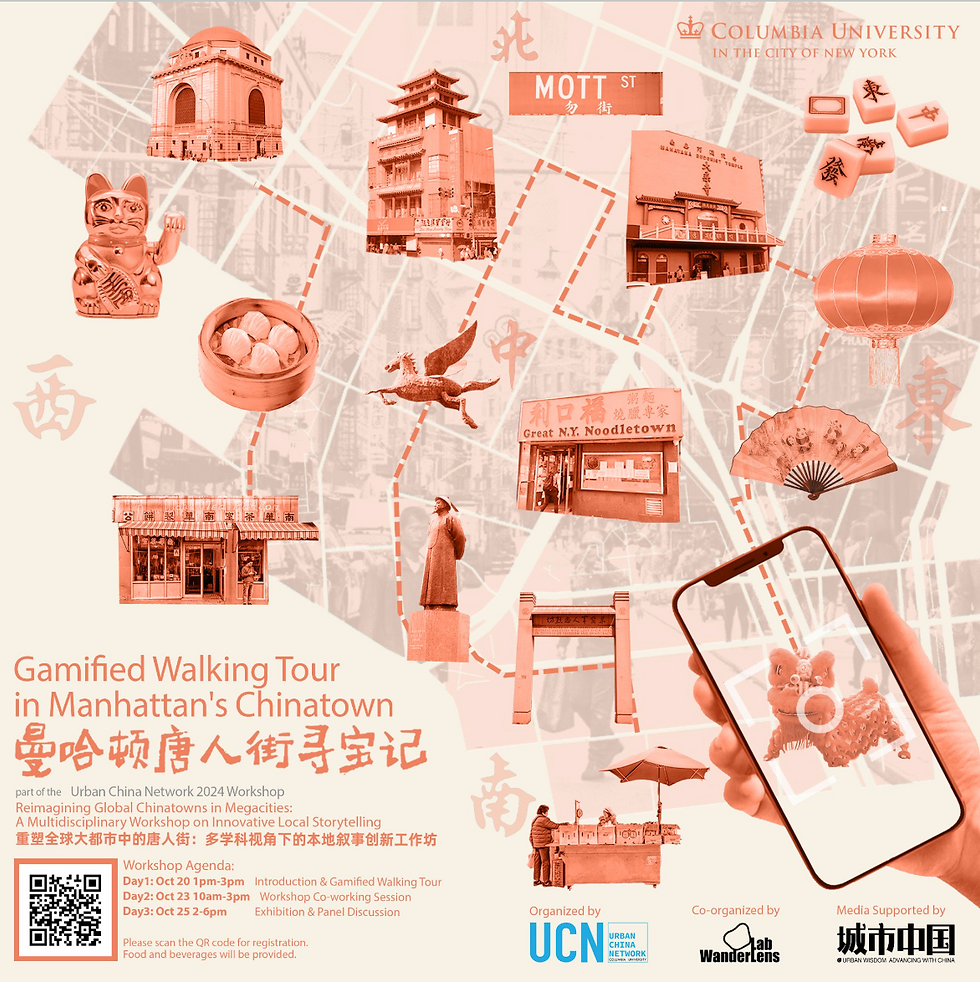
The Poster for the Activity
PREPARATION
CULTURAL PROBE DESIGN
To facilitate the observation and incorporate diverse personal narratives about Chinatown, we employed the “Cultural Probe” design method. Described by Thoring, Luippold, and Mueller (2013) as “a common method in design research for gathering qualitative data through participatory user self-documentation”, “Cultural Probe” involves a collection of tools and instructions for users to engage with over a specific period. In the cultural context, Tom Schofield et. al. (2018) used “Cultural Probe” as “sets of creative, speculative tasks given to participants in ethnographically-oriented design processes.”
We designed the tools of cultural probes and organized a walking tour in Chinatown, assisting the participants to observe the surroundings, elicit their personal feelings and laying a foundation for the next step: the co-creation of digital exhibition that represents various storytellings.

The related works
To enhance personal storytelling within heritage contexts, participatory design methodologies and digital technologies offer innovative tools. For instance, Kexue Fu et. al. (2024) employed Generative AI to capture personal narratives and future visions at cultural heritage sites. Participants were invited to create AI-generated images that expressed their personal connections and concerns about issues like over-tourism and climate change. Other researchers have adopted the participatory design approach to incorporate diverse voices about heritage and facilitate co-creation based on these narratives. Rachel Charlotte Smith (2013) led a “Digital Natives” exhibition, a design anthropological experiment where teenagers, anthropologists, and designers collaborated to explore future communications of cultural heritage. This initiative showcased the deep engagement of teenagers with digital media, transforming the exhibition into a vibrant space where heritage was actively co-created by participants and visitors in real time. Tom Schofield and others (2018) utilized cultural probes to uncover alternative heritage narratives from communities around the Theodosian Land Walls in Istanbul, Turkey. In this case, cultural probes not only collected personal data but also enhanced participant engagement and collaborative production of installations, thereby expanding the practical applications of these tools in heritage contexts.
More specific questions
How can visitors effectively participate in and contribute to the Chinatown community stories?
What personal and emotional connections between visitors and Chinatown can be established?
The assembly of cultural probe
The cultural probe consists of two components. The first component, the physical part, includes various items such as postcards, a self-guided map, word clouds, along with pens and paper. The second component, the digital part, utilizes mobile phone applications like the camera, audio recording, and 3D scanning tools. According to the framework proposed by Thoring, Luippold, and Mueller (2013), these tools serve documentary, practical, visionary, and inspirational purposes.

The Cultural Probes Toolkits

The Category and Function of Cultural Probes Toolkits
Based on three main topics related to Chinatown and various observational perspectives, several prompt questions were developed and printed on postcards. Each postcard features a question on one side and space for participants' responses on the other.
Examples of these prompt questions include:
-
What specific location in Chinatown makes you feel most connected to the community and why?
-
Find a place in Chinatown where you feel completely out of place. Why do you feel this way?
-
What dish would you say best represents Chinatown, and what is the story behind it?
-
How do older residents' views on Chinatown's future differ from those of younger residents?
-
Share a personal story or memory that you believe captures the essence of Chinatown.
-
What symbol would you choose to represent Chinatown, and why?
-
If you could preserve one aspect of Chinatown permanently, what would it be and why?
The postcards were designed to encourage participants to contemplate specific questions about Chinatown, serving as a framework for their observations. If participants were unsure how to answer, they were encouraged to engage with local residents, ask them these questions, and record their responses.

The Postcard with a Prompt Question
The example of the using illustration example from the artist, Sarita Sun, is presented to the participants to explain how to use illustration to document their observation in Chinatown.

The Example of Sketching (Reference: Sarita Sun, https://parsons.edu/dt-2022/the-chinatown-intention/)
The majority of the tools are intended for documentary purposes, such as pens, sketching paper, and all digital tools. The map of Manhattan's Chinatown is used by participants to sketch their exploration routes and mark significant locations with stickers.

Tool: Map of Self Exploration
The word cloud serves as supplementary material, encompassing all keywords related to the workshop's topics. If participants need inspiration or feel unsure about how to proceed, they can refer to these keywords to help guide their thoughts.

Tool: Tag Clouds
Besides the physical tool, the digital tools are also introduced in the digital tools, inclduing cameras, audio recorder and 3D scanning software with a short introduction of how to use the 3D scanner for documentation.

Tool: Your Phone! ——3D Scanner. (Reference: https://www.youtube.com/watch?v=ELXLFMjLOx8)
The results
During the group discussion following the walking tour, each participant shared their discoveries and points of interest. Several common themes emerged, including the distinctive smells of the seafood market, the sounds along the streets, and the open spaces where locals gather for leisure activities. Additionally, based on their observations and feedback from local residents, the group discussed the differing perspectives between the younger and older generations regarding the future vision of Chinatown.
The limitation and future work
Although the cultural probes effectively encouraged participants to link their personal experiences and memories with Chinatown, they struggled to document the artifacts or locations that inspired them. This challenge made it difficult to move on to the next phase of co-creation based on the materials collected. The primary issues were the time constraints and the physical demands of exploring the entire historic district of Chinatown in one afternoon, whereas cultural probe tasks typically span several weeks or even a month.
To enhance future workshops, we plan to extend the duration for observation, data collection, and creative ideation. This adjustment will provide participants with ample time to engage more deeply with the environment. Following this extended period, a co-creation session will be organized where participants can brainstorm and utilize both physical and digital tools to create artifacts that reflect their perspectives on Chinatown, their insights into its current socio-cultural dynamics, and their visions for its future.
INTRODUCTION OF THEMES
To prepare the walking tour, the participants are gathered in the First Chinese Baptist Church, the placwhere Dr. Bayer Lee worked as the priest. An open ceremony and introductory slides are prepared. The introductory section helps the participants learn about the background of Manhattan's Chinatown and the training section of how to use the cultural probe of collecting the stories and documenting personal feeling that the district gives to them.

Introduction of the History of Manhattan's Chinatown
The first topic is “Chinatown for Rent,” which primarily explores the issues of gentrification, urban renewal, and satellite towns that Manhattan’s Chinatown faces during urban development. Many Chinatowns in North America confront demolition or have undergone extensive renovations, while Manhattan’s Chinatown has preserved the framework established since the 19th century for various reasons, serving as a living relic in the study of immigrant urban spaces. Although today, the old Chinatown no longer houses a large number of immigrants, and many properties are leased to businesses that cater to the stereotypical image of Chinese culture. What we could observe from the urban environment stem from multiple factors such as real estate, urban planning, sociology, and economics. Through the lens of Chinatown, can we explore the urban issues related to the city and suburb; land and residents; development and preservation? (Credit to Fei Deng & Christina Sun)
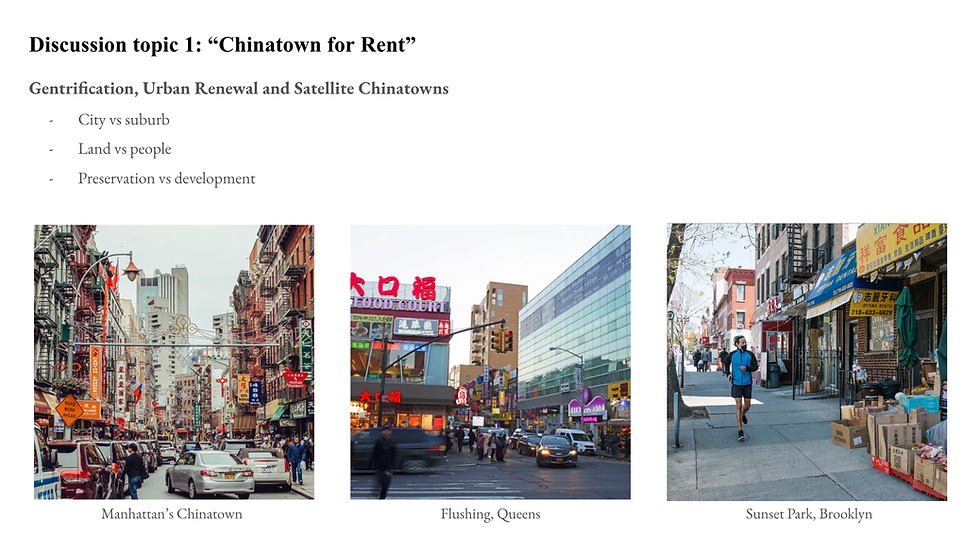
Topic One
The second topic is “Chinatown for design,” the main focus is on how to shape the Chinese characteristics and identity of Chinatown through design and creative ways. One unavoidable topic when discussing Chinatown is: What exactly constitutes the Chinese style of Chinatown? In the early formation of Chinatown, the Lower Mott Street area was lined with numerous restaurants adorned in Chinese-style decor, attracting customers with the allure of mysterious Eastern culture and aesthetics, reflecting the immigrants' understanding of Chinese style. There are many other spaces in Chinatown that embody distinct Chinese characteristics. What are some of these spaces? What are the iconic activities associated with them? What aspects of immigrant history and culture do these distinctive spaces reflect? How did people in the past achieve their designs, and what design methods and approaches do we have today to create new representations of Chinese identity? (Credit to Fei Deng & Christina Sun)

Topic Two
The third topic is “Chinatown for living,” regardless of how the urban functional positioning of Chinatown changes, Chinatown remains the heart of the Chinese immigrant community. It is a container for stories about "people," intertwining individuals from different times and experiences. From the 1870s to the present, Manhattan’s Chinatown has experienced countless community-related historical events and has inevitably been influenced by major historical events of the whole society: from the era of exclusion to inclusion, the struggles during the Cold War era, and later the impacts of 9/11 and Covid in the 21st century. Community insiders have come and gone, leaving behind their own stories that annotate Chinatown. The surrounding urban neighborhoods have also witnessed Chinatown’s development, contributing an outsider’s perspective to the narrative of Chinatown. What is Chinatown? Whose Chinatown is it? What does it mean for Chinese immigrants in terms of identity? What does Chinatown represent for the younger generation? How does Chinatown exist within the city? This time, we will become the listeners, recorders, and presenters. We will collect stories from different individuals and, with the help of various technologies and skills, restore and continue the narratives of the people and Chinatown. (Credit to Fei Deng & Christina Sun)
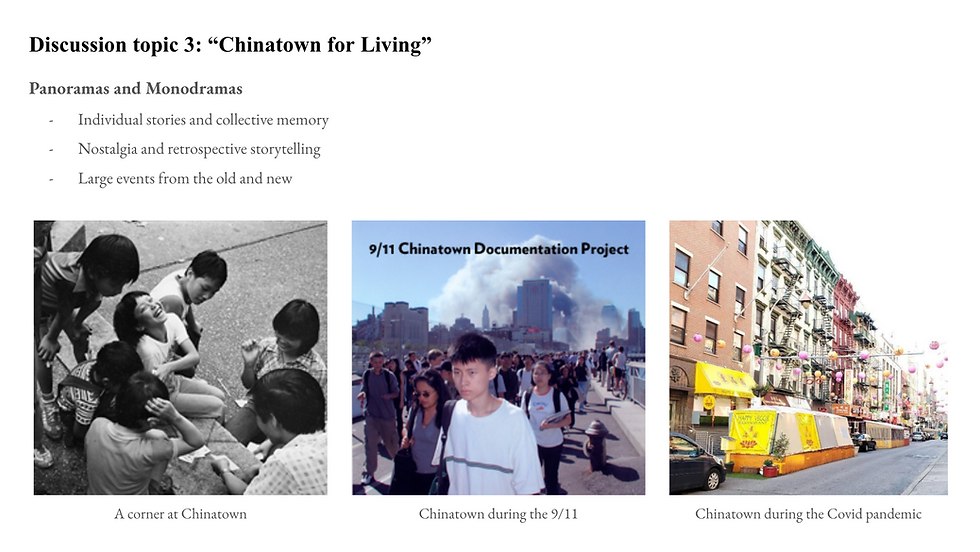
Topic Three
WALKING TOUR
The walking tour was guided by Dr. Bayer Lee. The route of the walking tour started from the Pell Street, one of the oldest street of Chinatown, covering important places for the community including, First Chinese Baptist Church, the former residence of Mable Lee, a celebrated female figure who contributed to the community engagement and the fight for female rights, and Seward Park. Dr. Lee introduced the historical changes happened in the districts and the contribution of Mable Lee.

Dr. Lee Introduced the Development of Chinatown ©️COMA aka Chinatown Organization for Media Awakening

Dr. Lee Introduced Mable Lee ©️COMA aka Chinatown Organization for Media Awakening

Dr. Lee Introduced the History of Chinatown ©️COMA aka Chinatown Organization for Media Awakening

Dr. Lee Introduced the development of Chinatown ©️COMA aka Chinatown Organization for Media Awakening

Discussion with the community members ©️COMA aka Chinatown Organization for Media Awakening
Walking tour in Manhattan’s Chinatown with Pastor Bayer Lee. ©️COMA aka Chinatown Organization for Media Awakening
PARTICIPATORY WORKSHOP
After the walking tour, the participants regathered to the church to share their observation and expereince based on what they have documented through the cultural probes. In addition, the memebrs from the Chinatown community were also invited to the dicussion, who provided the perspectives from insiders. From the sharing and the reflection of the participants of the walking tour, several interesting topics including the nastagia smell that they noticed on the street and the gathering in the park. In addiiton, the participaation of the community members also provide another perspective, which led to the discussion of the worry of the Chinatown's future and the different opinions between the elder generation and the younger generation.

The Preparation of the Discussion

The Discussion between the Participants and the Community

The Illustration on the Map from One Participant
PANELISTS
After the walking tour, we organized a panelists discussion which was held in GSAPP, Columbia University. We invited the guests including the researchers of Chinatown, the policy maker and the media artist, the filmmaker and the photographer, to discuss their ideas about Chinatown and their works, which is a joint reflection of how to use digital media for the storytelling of Chinatown.
The panelist discussion included two sessions. Session A was about Community Engagement, and Session B was about Multi-media Narratives. Each session included the presentations frm the guests and the following disucssion.

The Poster of the Panelist Disucssion

The Presentation in Session A
.jpg)
The Discussion in Session A

The Discussion in Session B
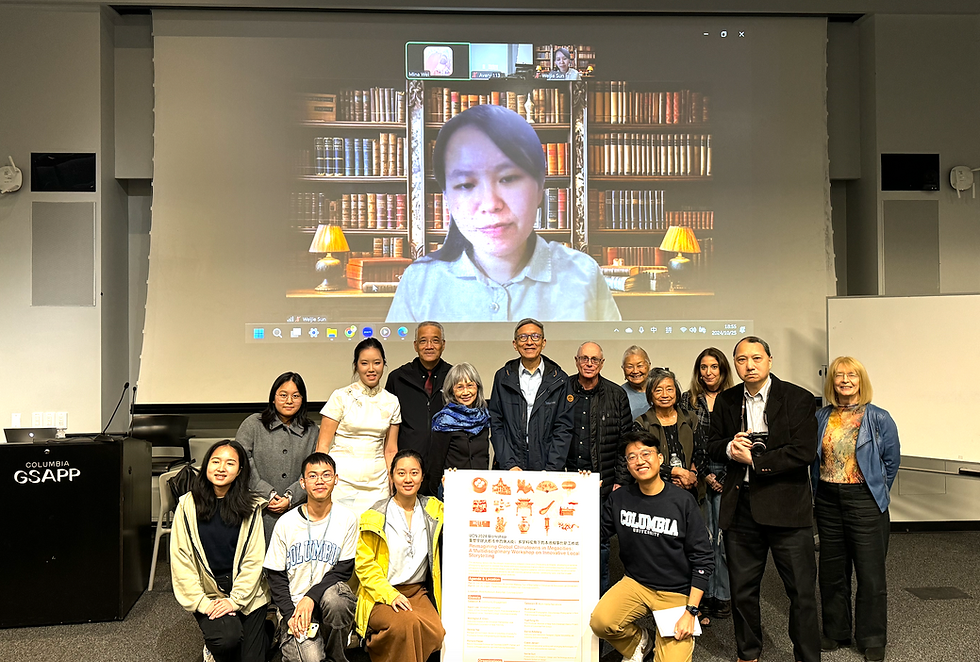
All the Participants of the Panelist Discussion
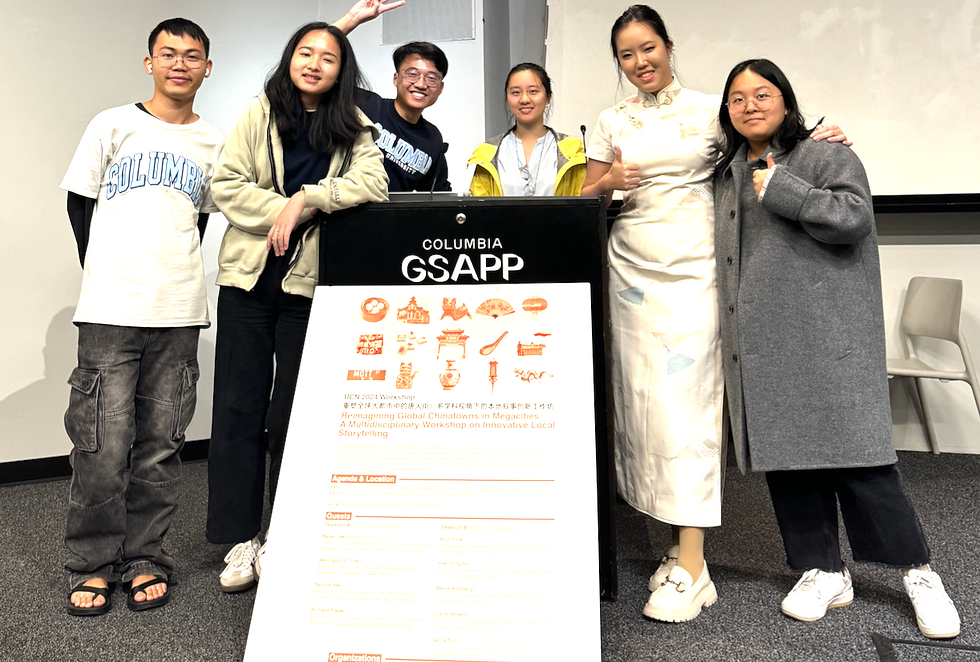
All the Organizers of the Panelist Discussion
REFERENCES
Thoring, K., Luippold, C., & Mueller, R. M. (2013, August). Opening the cultural probes box: A critical reflection and analysis of the cultural probes method. Paper presented at the 5th International Congress of International Association of Societies of Design Research (IASDR), Tokyo, Japan.
CONTRIBUTION
Zihao Zhang: Walking Tour Presentation & Organization, Workshop Coordination, Panelist Liaison, Panel Discussion Host
Daoxin Chen: Cultural Probe Design, Walking Tour Presentation & Organization, Workshop Coordination, Panelist Photography
Mina Wei: Walking Tour Presentation & Organization, Workshop Coordination, Panelist Host & Preparation
XXX: Walking Tour Organization, Panelist Preparation
Hongqian Li: Poster Visual Design
Mengyao Chen: Panel Discussion Host
Bayer Lee: Walking Tour Guide, Panelist Presentation & Discussion
Fei Deng: Historic Material Provision, Walking Tour Presentation & Organization
Christina Sun: Historic Material Provision, Panelist Presentation & Discussion, Panelist Liaison
YOU MAY ALSO LIKE

DigiDine | MR for Food Heritage
2024
